⛽ Everything You Need to Know (2026)
Anyone traveling to Greece by car or renting a car there will quickly notice: Fuel is more expensive than in Germany – but there are significant differences depending on the region and island.
Gasoline prices are among the highest in Europe.
However, with a little planning, it’s easy to save money, especially on longer journeys or island tours.
In this article, you’ll learn:
the current prices for gasoline, diesel, and LPG,
how refueling works in Greece,
where to find the cheapest fuel,
and tips to help you avoid unnecessary costs.
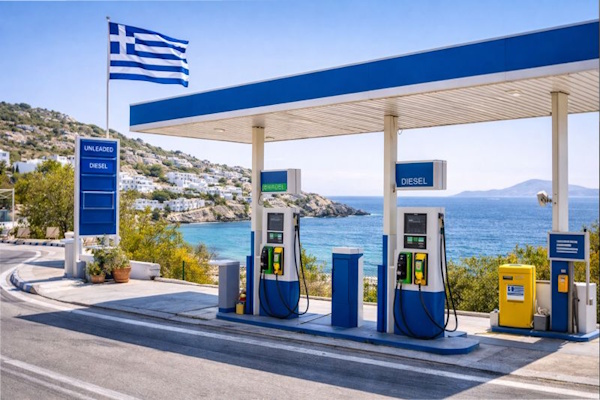
1. Current Gasoline Prices in Greece (2026)
Gasoline prices in Greece fluctuate daily – depending on the region, the price of oil, and taxes.
For years, Greece has ranked in the top third in European comparisons.
(As of spring 2025, rounded average values)
| Fuel type | Price per liter (€) | remark |
|---|---|---|
| Super (95 octane) | approx. €1.95 | On islands, sometimes over €2.10 |
| Super Plus (98 octane) | approx. €2.10 | High-priced, only available at larger stations |
| Diesel | approx. €1.70 | Greater fluctuations by region |
| Autogas (LPG) | approx. €1.05 | Widespread on the mainland |
| E10 and E5 | similar to Germany | not available everywhere |
Tip:
Gasoline is usually 10–20 cents more expensive on islands than on the mainland.
Transporting fuel by ship drives up prices.
2. Price differences between regions & islands
Prices vary greatly between urban and rural areas.
| Region / Island | Super (95) | Diesel | Special feature |
|---|---|---|---|
| Athens / Piraeus | €1.88–1.92 | 1,65 € | cheapest region |
| Thessaloniki / Northern Greece | €1.85–1.90 | 1,63 € | many gas stations, competition |
| Peloponnes | 1,90–1,95 € | 1,68 € | relatively stable |
| Crete | 1,98–2,05 € | 1,72 € | depending on the region |
| Rhodes | 2,05–2,10 € | 1,75 € | more expensive due to island transport |
| Santorini / Mykonos | €2.10–2.25 | 1,78 € | Top prices |
| Naxos / Paros | 2,00–2,10 € | 1,73 € | moderate |
| Mainland (Egnatia motorway) | 1,88 € | 1,65 € | Motorways are more expensive than secondary roads. |
3. How refueling works in Greece
Refueling in Greece is a bit different than in Germany – often more personal and straightforward.
⛽ Service refueling is the norm
At almost all gas stations, you’ll be served:
An attendant will fill your tank while you stay in your car.
You simply say:
“Full, please” – for a full tank,
or state the amount: “Twenty euros, please” (€20).
You only pay afterward, usually directly at the pump.
Self-service is sometimes available only at motorway service stations.
💳 Payment
Cash is the norm.
Card payments (Visa, Mastercard) are accepted almost everywhere, but it’s best to have cash on hand in small villages.
In rare cases, prepayment is required – especially at night.
⏰ Opening hours
Gas stations are often open from 7:00 a.m. to 10:00 p.m., and 24/7 at motorway service stations and in major cities.
Many smaller stations are closed on Sundays.
Book accommodation in Greece now
Our tip
For hotels in Greece, the best option is Booking.com: a wide selection from guesthouses to resorts, genuine guest reviews, flexible (often free) cancellation, and fair prices.
4. Major petrol station chains in Greece
The best-known providers (represented nationwide):
| brand | Special features |
|---|---|
| EKO | Largest chain, reliable, good quality |
| Shell Hellas | Many stations, clean, credit cards accepted |
| AVIN | Often found on islands, moderate price |
| BP | in cities, mostly modern facilities |
| Aegean | Greek brand, often cheaper |
| Elin / Cyclon | local, mostly on islands |
💡 Tip:
If you’re driving a rental car, it’s best to fill up at major brands – fuel quality is guaranteed there.
5. Quality & Scams – What to Look Out For
Fuel quality in Greece is generally good, but there are occasionally some shady operators, especially at very small, remote gas stations.
Pay attention to:
The price per liter on the display board.
Whether the meter starts at zero.
No distractions while refueling.
Always ask for a receipt.
The authorities conduct regular checks, but a quick glance never hurts.
6. Saving Money on Fuel in Greece
Fill up on the mainland, not on the islands.
Filling up before the ferry can easily save €10–15.
Fill up in cities, not on highways.
Highway gas stations are up to 20 cents more expensive.
Pay attention to the time of day.
Prices are more stable in the mornings and late mornings, while they often rise slightly in the evenings.
Use apps:
fuelgr.gr or FuelGR (Android/iOS) show prices in real time.
Google Maps also often displays current gasoline prices in Greece.
For longer trips with a rental car:
Always fill up shortly before returning the car, ideally near the airport, but not directly at the rental station (usually more expensive).
See also: Prices in Greece – all the information for tourists
7. Refueling with a rental car
In Greece, there are no self-service pumps like in Northern Europe.
So you always have to go to the cashier or the attendant.
Important:
Check the refueling policy in the contract: usually “full-to-full”.
Keep the receipt – you may be asked for it when returning the car.
Fuel type: Rental cars almost always run on 95 octane premium gasoline; diesel is much less common.
Tip: Before setting off, ask which type of gasoline is permitted.
Choosing the wrong fuel can be expensive – and is a common mistake made by tourists in Greece.
8. Special Features of the Islands
Crete
Long distances, many mountain roads → higher fuel consumption.
Price differences between the north and south coasts.
Good density of gas stations.
Rhodes
Prices slightly above mainland levels.
During peak season (July–August), they often increase by 10–15 cents.
Santorini / Mykonos
Very expensive (transport costs).
Gas stations often close early – always fill up in time!
Naxos / Paros
Moderate, usually fair.
In small villages, it may be that only one station is open.
Corfu
Many gas stations, cheaper than on other islands.
Good availability of diesel and LPG.
9. Diesel & Autogas (LPG)
Diesel
Primarily used by locals.
Clean diesel cars are permitted, but older vehicles (Euro 3 or older) are sometimes banned from driving in the city centers of Athens and Thessaloniki.
Diesel is about 20–25 cents cheaper than gasoline, making it an attractive option.
LPG (Autogas)
Widely available on the Greek mainland.
Price: €1.00–€1.10 per liter
Inexpensive, but the refueling network on the islands is limited.
Stations are usually marked with a sign for “LPG” or “Ygraério” (Ygraério).
For tourists with their own LPG-powered vehicles, it’s only worthwhile on mainland routes.
10. Electric Cars & Charging Stations
Electric mobility is still in its infancy in Greece.
However:
More and more public charging points are being installed in Athens, Thessaloniki, and Crete.
Many hotels now offer outlets or wallboxes.
Key providers:
DEI Blue (public electricity provider)
Blink Charging
Fortizo
💡 App tip:
Use “ChargeMap” or “PlugShare” to find all available charging stations in Greece.
11. Tolls, Roads & Combining Charging with Fuel Consumption
Anyone traveling through Greece by car should factor toll costs into their budget.
They are moderate, but add up over long distances.
| Route | Toll costs (approx.) | distance | Petrol costs (Super €1.95) |
|---|---|---|---|
| Athens – Thessaloniki | 35 € | 500 km | approx. €55–60 |
| Athens – Patras | 15 € | 210 km | approx. €25 |
| Athens – Kalamata | 13 € | 240 km | approx. €27 |
| Heraklion – Chania (Crete) | no toll | 145 km | approx. €17 |
👉 Average fuel consumption on mountain roads: 6–8 l/100 km
Consumption increases, especially on islands, due to numerous curves and elevation changes.
12. Safety & Conduct at Gas Stations
Turn off the engine, put away your cell phone – no smoking!
Never stay in the car while refueling (especially with LPG).
Ask for a receipt – it can sometimes help in rental car disputes.
Refuel at night: only at well-lit, busy stations.
Don’t fill the tank to the brim – fuel expands in the heat.
13. Environment and Sustainability
Greece is increasingly striving for more environmentally friendly mobility:
Tax breaks for electric cars
Promotion of solar energy
Expansion of the charging infrastructure on islands
Nevertheless, traffic remains heavily reliant on gasoline – primarily due to tourism.
Those who want to show environmental awareness can:
Carpool,
Rent scooters or e-bikes,
Travel short distances on foot or by bus.
14. Typical questions about refueling in Greece
➡️ Is E10 available in Greece?
Rarely. Most stations carry regular Super (95).
➡️ Can I pay with a debit card?
Mostly only with credit cards (Visa, Mastercard). Debit cards (Girocard) often don’t work. See: Money in Greece
➡️ How much does diesel currently cost in Crete?
On average €1.72–1.75 (2025).
➡️ Are there self-service pumps?
Only at a few modern stations, e.g., Shell in Athens or Thessaloniki.
➡️ What should I do if I’ve filled up with the wrong fuel?
Do not start the engine, inform the attendant immediately. Garages are usually reachable within 15 minutes.
15. Conclusion: Refueling with a clear plan and a relaxed attitude
Refueling in Greece is easy if you know the differences.
Prices are higher than in Central Europe, but the experience is more personal – you’ll receive friendly service almost everywhere.
With a little planning and local knowledge, you’ll save money and hassle:
Refuel on the mainland or in cities,
keep your receipts handy,
and plan for sufficient range for island routes.
Then nothing stands in the way of relaxed road trips through sunshine, olive groves, and small mountain villages.
👉 In short:
Refueling in Greece costs more – but with knowledge, timing, and a relaxed attitude, it remains stress-free and straightforward.
Prices & money in Greece
| Prices Greece | Food prices Greece |
| Petrol prices Greece | Cigarette prices Greece |
| Alcohol prices Greece | Tipping Greece |
| Money Greece | Lidl Greece |