Time in Greece
The time on the Greek islands is always one hour later than in Germany. So when it is 12 noon in Germany, it is 1 p.m. in Greece. This applies to winter and summer time. The time change always takes place on the same day.
Language
The Greek language is quite difficult to learn. You should at least know the Greek alphabet before your vacation. However, almost every Greek can speak some English. Street signs, menus, timetables, etc. are usually bilingual. In Greece, tourists are rarely expected to know Greek. Here is a good Greek dictionary in a small format to take with you on your trip to Crete.
Doing laundry in Greece
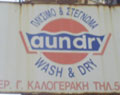
If you don’t want to wash by hand: There are laundromats on the larger islands. However, these are usually relatively expensive (between 6 and 12 euros).
Toilets in Greece
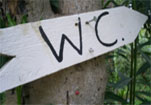
Public toilets are not often found. Larger bus stations have a public toilet. You can simply use toilets in bars, restaurants or hotels. You should always throw the toilet paper in the small bucket next to the toilet and not in the toilet. The Greek sewage pipes are too small in diameter and will clog if you throw the paper in the toilet.
Tip: Hotels in Greece should be booked online. Prices are usually much cheaper and easier to compare. The best place to book is Booking.com.
post
The postal service in Greece is often quite slow. A postcard or letter to Germany can take between 3 days and 2 weeks to arrive. In rural areas there are no postmen. You pick up letters and packages from the post office.
Units
Like Germany, Greece uses the metric system. Wine and other drinks are often listed in kilos on the drinks menu. Half a kilo of wine is therefore equivalent to half a liter.
Taking photos and filming
All film and photo material is available in Greece, but is a bit more expensive than in Germany. The same applies to developing films. Batteries are also more expensive. Taking photos of military installations or airports, for example, is strictly prohibited.
Crime in Greece
Still very low. Theft is quite rare in Greece. This is a big plus point for trips to Greece compared to Spain or Italy. Be careful with drugs: even for a joint you can end up in prison for a few days or weeks and Greek prisons are not the most pleasant. There is a special tourist police force. Everyone in their offices speaks English and you can usually find an officer who speaks German. Since the major economic crisis in 2010, crime in Greece has increased. However, this applies less to the islands and more to the greater Athens area. The city center around Omonia Square and the streets around the port of Piraeus are considered crime hotspots. In particular, drug addiction crime and poverty crime by illegal immigrants are becoming an increasingly serious problem.
Still no hotel for your holiday in Greece?
|
Holidays in Greece
1st January (New Year), 6th January (very important holiday in the Orthodox faith), 25th March (Independence Day from the Turks), Good Friday, Easter Sunday (the most important day of the year, even many ferries and buses do not run on this day), Easter Monday, 1st May (Labor Day), 15th August (Assumption of Mary), 28th October (“Ochi” Day, the day in World War II when the Greeks said “Ochi” = no to the Italian invasion), 25th and 26th December (Christmas).
If a holiday falls on a Sunday or public holiday, it is made up for on the next working day (usually Monday). In 2016, 1st May was on Easter, so Easter Tuesday was also a holiday. Greek (Orthodox) Easter is not always on the same weekend as our Easter. It is sometimes a few weeks later. It is calculated according to a different calendar. This also has an impact on carnival, which is also celebrated in Greece. Carnival strongholds include Patras in the Peloponnese and Rethmyno (Crete).
Information
Greek National Tourist Office, Neue Mainzer Str. 22, 60311 Frankfurt/Main, Tel. 069/23656163 Fax.: 069 /236576
Accommodation can be booked online. The best site with lots of cheap offers is Booking.com. An incredible 25,000 hotels, guest houses and holiday apartments in Greece can now be booked on this website.
Tourist information is available on the larger islands and varies in quality. It is better to trust travel guides or similar.
Opening times
Shops: Very different. In tourist areas 7 days a week from 8 a.m. to midnight. In cities mostly in the morning (Mon – Sat) and in the evening from 5 p.m. to 9 p.m. However, many shops are only open on Monday, Wednesday and Saturday mornings. Supermarkets are usually open all day, but only some on Sundays.
Banks: Very short opening hours. For example, Monday to Friday from 8 a.m. to 2 p.m. Fortunately, there are ATMs everywhere.
Post office: In the countryside, only Monday to Friday from 8 a.m. to 2 p.m. It varies in cities, but usually much longer.
Museums: These are often closed on Mondays. The large museums, such as the Archaeological Museum in Iraklion, are also open on Mondays. With an international student ID, the entrance fee is often greatly reduced. Tip: Many museums have no admission charge on the first Sunday of the month or on all Sundays.
Automobile clubs
“Greek ADAC”: it’s called ELPA. Head office in Athens, of course: Odos Messogion 2.
Shopping
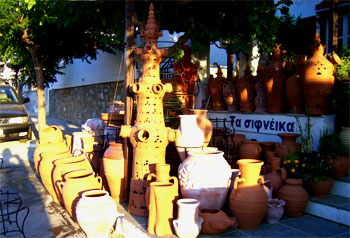
Leather goods, ceramics, jewelry, honey, olive oil and backgammon games are often bought as souvenirs in Greece. Leather items are quite cheap and can be bought, for example, in the “Leather Street” in Hania (Crete). There, in an alley in the old town, there are a few good leather shops. Ceramics are usually in the Greek national colors of blue and white. Silver and gold jewelry can be found in many shops. However, you should be aware of the prices. Not everything is always handmade, even if it says so. Olive oil (a frequently bought souvenir) is better bought in small village shops; it is often much more expensive in souvenir shops. Backgammon (Tavli) is played in almost every bar in Greece. Chess is also very popular in Greece. There are games in every price range. The export, possession and purchase of antiques is strictly prohibited (high fines or even prison sentences).
Groceries are generally cheaper in specialty shops (butchers, bakers, fruit and vegetable shops) than in supermarkets. Even in supermarkets, open sausage, meat, cheese or olives are cheaper at the counter than in the self-service refrigerator section. The cheapest supermarkets are the foreign chains (especially Lidl, on the mainland and on the 10 or so most populous islands). Greek supermarkets are more expensive than in Germany, with ready-made products in particular having higher prices. The many Carrefour branches in Greece also have a good selection and relatively low prices.
Alcohol is quite cheap. Beer and liquor costs about the same as in Germany. Wine is of course much cheaper. You can get 5 liters of wine for 8-10 euros, and it’s usually not that bad. Cigarettes are much cheaper than in Germany. The Next and Leader brands are the cheapest (around 2 euros). International cigarette brands like Marlboro cost around 3 euros per pack. However, cigarette prices are set to rise again soon in Greece.
Do you have feedback, an addition, found an error or a comment? Send us an email to: mail@griechenland-insel.de