😺 Life, Behavior & Animal Welfare
Cats are as much a part of Greece as the sun, the sea, and olive trees.
You’ll find them in almost every village, at every taverna, and on every beach – sometimes curious, sometimes cautious, often begging for a piece of fish.
For many tourists, they’re part of the quintessential Greek experience, but the reality behind the cute pictures is often more serious.
In this article, you’ll learn all about the lives of cats in Greece, why there are so many strays, how you can help, and what you should be aware of as a tourist.
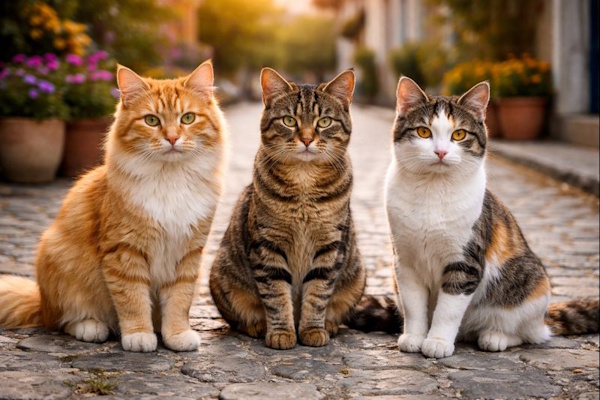
🐾 Cats are a common sight in Greece
Hundreds of thousands of cats live in Greece – a large proportion of them without owners.
They usually don’t belong to any particular household but are regularly fed by residents, taverna owners, or tourists.
They are especially ubiquitous on islands like Santorini, Crete, Naxos, Paros, and Rhodes.
They sit on warm walls, sleep between boats in the harbor, or bask in the sun in front of tavernas.
To many visitors, the cats appear relaxed and well-cared for, but behind these idyllic images lies a life full of challenges.
🍽️ Why there are so many cats in Greece
Greece has a warm climate, few natural predators, and many open garbage dumps – ideal conditions for cats to reproduce.
The main reasons:
Inconsistent spay/neuter programs
Cats have 2-3 litters per year
Many people feed them but don’t take responsibility
On islands, cats often live in isolation without veterinary care
Estimates suggest there are over one million stray cats throughout Greece.
🏝️ Cats on the islands
🐈 Crete
On Crete, almost every village has cat colonies. In tourist areas like Chania or Rethymno, they are often fed, but in the mountains, they struggle to survive.
🐈 Rhodes
In Rhodes Town and Lindos, the cats are practically an attraction. Many tavernas provide water bowls. Several animal welfare organizations take care of spaying and neutering.
🐈 Santorini
The white houses and cats on the walls of Oia are world-famous – they appear in almost every vacation photo. But behind the scenes, many cats live without medical care.
🐈 Naxos & Paros
Here, the cats are calmer and more trusting. Many farms keep them to keep mice away.
🐈 Athens & Thessaloniki
Many stray cats also live in the cities – especially in cemeteries, parks, and around monasteries. There, they are fed by residents and given medical care by animal welfare groups.
❤️ Behavior & Character
Greek cats are usually born outdoors and live in groups.
They are independent but accustomed to people – a mix of wild and tame.
Many allow themselves to be petted, and some even come onto your lap once they trust you.
Typical characteristics:
They sleep during the day and become active in the evening.
They remember who feeds them.
They are territorial – each group has its own territory.
Males often roam alone.
🍗 Should you feed cats while on vacation?
This is a frequently asked question – and the answer is: Yes, but do it responsibly.
If you feed them:
Give only small amounts (cooked meat, cat food, nothing spicy)
Put out water – many cats suffer from thirst
Don’t feed them directly at tavernas (this leads to conflicts)
Don’t leave any trash behind
💡 Tip:
Many places have “feeding stations” – official feeding spots with water containers. You can help there without getting into trouble.
🏥 Diseases & Veterinary Care
Most stray cats are healthy, but parasites and infections are common.
Typical problems:
Fleas, ticks, mites
Feline herpesvirus (especially in kittens)
Dental problems and eye infections
Malnutrition in winter
Veterinarians are available in all larger towns, but are scarce on smaller islands.
Animal welfare organizations regularly organize spay/neuter campaigns with volunteers from all over Europe.
🐱 Spay/Neuter Programs & Animal Welfare
The situation for stray cats is slowly improving – thanks to many dedicated organizations:
Important animal welfare organizations in Greece:
Nine Lives Greece (Athens) – the largest organization for stray cats
Greek Cat Welfare Society (Rhodes)
Cat Rescue Chania (Crete)
PAWS Naxos – a small, local initiative
Santorini Cat Welfare Association (SCWA)
These groups:
feed several hundred cats daily
organize spay/neuter programs
rehome animals abroad
educate tourists on proper behavior around cats
Those who would like to donate or help can find information on their websites (often also in German or English).
✈️ Adopting cats – is that possible?
Yes, but only through official channels.
Many organizations rehome Greek cats to Germany, Austria, or Switzerland.
The process:
Health check & vaccinations
Microchip & EU pet passport
Rabies vaccination (at least 21 days old)
Transport with a flight escort
Never take a cat with you in the trunk of your car – this can lead to legal problems.
💡 Flight escorts are tourists who take a cat that has already been rehomed with them on their return flights – simple and legal.
🐾 Why cats are important for the ecosystem
Cats keep the number of mice and rats down, especially on islands.
They help protect supplies and reduce insects.
That’s why many villagers tolerate them – they are part of the balance of nature.
📷 Cats as photo subjects
Hardly any tourist leaves Greece without at least one cat photo.
The animals are often photogenic and move freely in the most beautiful settings.
💡 Tip:
Avoid using flash and keep your distance. Cats are sensitive to bright light.
The most beautiful photos are taken in the morning or just before sunset.
🧭 Conclusion: Cats in Greece – beautiful, but vulnerable
Cats are an integral part of everyday Greek life. They bring villages, tavernas, and harbors to life.
But many live on the streets and depend on help.
Those who feed them, donate, or simply treat them with respect contribute to ensuring that Greece remains a good home for its cats.
A friendly glance, a bowl of water, and a little understanding – often, that’s all it takes to do good.
Animals in Greece – all our pages