🦅 Eagles, Falcons & Vultures Between Mountains and Sea
Greece is one of the most bird-rich countries in Europe – and particularly famous for its impressive birds of prey.
Between the mountains of the north, the gorges of Crete, and the Aegean coast, eagles, buzzards, falcons, and vultures live, perfectly adapted to the warm winds and rocky landscapes.
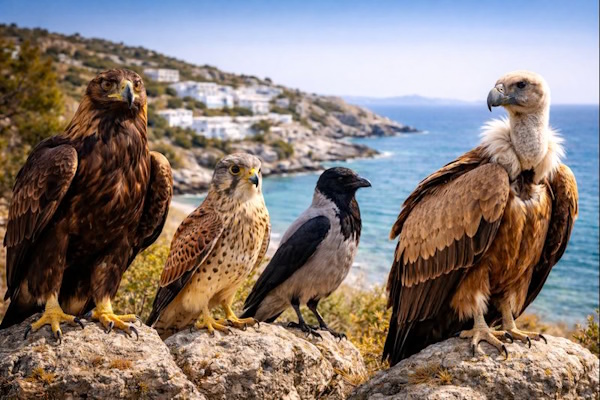
While you need luck to see an eagle in Central Europe,
more than 35 species of birds of prey can be regularly found in Greece – many of them year-round.
This article introduces the most important species, explains where you can see them, and gives tips for birdwatchers and nature lovers.
🌍 Why Greece is a Paradise for Birds of Prey
Greece is topographically extremely diverse: high mountains, deep valleys, large uninhabited areas, and sparse development.
Add to that the mild climate with more than 300 days of sunshine a year, ideal thermals, and an abundance of food.
That’s why birds of prey find ideal living conditions here:
Extensive hunting grounds with mice, lizards, snakes, and birds
High cliffs for nesting
Minimal human disturbance in mountainous regions
Strong updrafts (thermals) over mountains – ideal for soaring
The Pindus Mountains, Mount Olympus, the Vikos Gorge, the Rhodes Mountains, and the White Mountains of Crete (Lefka Ori) are particularly attractive.
🦅 The most famous birds of prey in Greece
🦅 1. Golden Eagle (Aquila chrysaetos)
The majestic golden eagle is the king of the Greek skies.
It lives primarily in northern and western Greece – in the Pindus Mountains, on Mount Olympus, and in Epirus.
Wingspan: up to 2.20 m
Weight: up to 6 kg
Diet: Hares, reptiles, birds
Nests in cliff faces or old trees
Year-round in Greece
💡 Observation tip: In the Vikos Gorge or at Lake Kerkini, there’s a good chance of seeing pairs of eagles circling in the sky.
🦅 2. Short-toed Eagle (Circaetus gallicus)
As the name suggests, this medium-sized eagle feeds mainly on snakes and lizards.
It prefers open landscapes, dry hills, and olive groves.
Size: approx. 70 cm
Wingspan: up to 1.8 m
Recognizable by its light underside and round head
Very common in the Peloponnese and Crete
💡 Especially in spring, it is often seen circling above sun-warmed slopes.
🦅 3. Booted Eagle (Aquila pomarina)
A small but agile eagle that breeds regularly in Greece.
It lives primarily in the north (Macedonia, Thrace, Evros Delta).
Size: up to 65 cm
Wingspan: up to 1.6 m
Eats mice, lizards, and small birds
Migratory bird – arrives in April and migrates to Africa in autumn
💡 Best time to observe: May to September
🦅 4. Bonelli’s Eagle (Aquila fasciata)
This elegant eagle with a light-spotted belly is rare,but can be found in Crete and the southern part of the mainland.
It nests in rocky gorges and hunts over olive groves.
Wingspan: 1.6–1.8 m
Diet: Pigeons, crows, small mammals
Threatened by power lines and loss of nesting sites
💡 On Crete, the Bonelli’s Eagle is a real insider tip for experienced birdwatchers.
🦅 5. Common Buzzard (Buteo buteo)
Europe’s most famous bird of prey is also widespread in Greece.
It is often seen circling over fields – searching for prey.
Size: approx. 55 cm
Present year-round
Often seen in groups, especially in winter
💡 Particularly common in the north and on the islands of Euboea, Corfu, and Crete.
🦅 6. Common Kestrel (Falco tinnunculus)
The common kestrel is one of Greece’s most adaptable birds of prey.
It lives everywhere – in cities, fields, and mountains.
Size: 30–35 cm
Typical behavior: Hovering over fields
Eats mice, grasshoppers, and small birds
Visible year-round
💡 Particularly easy to spot in cities like Athens or on Santorini.
🦅 7. Peregrine Falcon (Falco peregrinus)
The fastest bird in the world also lives in Greece!
It hunts other birds at speeds exceeding 300 km/h in a dive.
Breeding pairs on cliffs and ancient ruins
Location: Crete, Peloponnese, Chalkidiki
Protected and stable population
💡 Particularly common along steep coastlines and rocky islands.
🦅 8. Egyptian Vulture (Neophron percnopterus)
The Egyptian Vulture is the smallest vulture in Europe and easily recognizable by its white plumage and yellow face.
In Greece, it lives primarily in the north and on Crete.
Wingspan: up to 1.7 m
Feeds on carrion, insects, and small animals
Migratory bird – arrives in March and migrates to Africa in autumn
💡 On Crete, it can be observed in the vicinity of the Samaria Gorge.
🦅 9. Griffon Vulture (Gyps fulvus)
One of the most impressive birds of prey in Greece.
The griffon vulture lives in colonies and soars majestically over rocky landscapes.
Wingspan: up to 2.7 m
Weight: up to 9 kg
Diet: Carrion
Main habitats: Crete, Meteora, Rhodes, Peloponnese
💡 Best seen at Kotsifou Gorge (Crete) or Meteora.
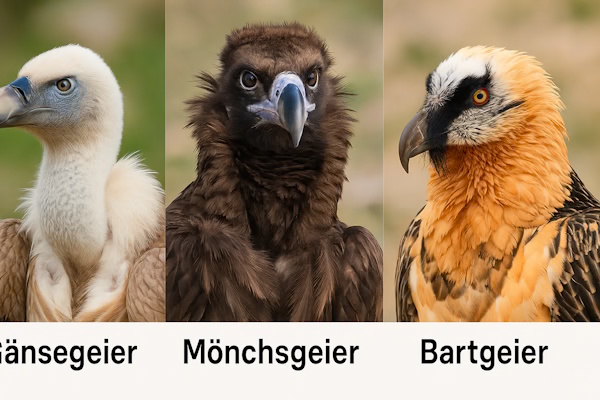
🦅 10. Cinereous Vulture (Aegypius monachus)
The rarest vulture in Europe, but still represented in Greece by a small population.
It lives in the northeast (Thrace, Dadia Forest).
Wingspan: up to 3 m
Dark brown, robustly built
Breeding colony in Dadia National Park, protected by WWF projects
💡 Best viewing opportunity: April–September in the Evros Delta and Dadia Park
🏞️ The best places to observe birds of prey in Greece
| Location | Region | Types | Special features |
|---|---|---|---|
| Dadia Forest National Park | Thrace | Eagles, vultures, buzzards | the most important bird of prey area in Greece |
| Lake Kerkini | Northern Greece | Eagles, buzzards, pelicans | large wetland; top spot for birdwatchers |
| Vikos Gorge | Epirus | Golden eagles, falcons | spectacular rocky landscape |
| Mount Olympus | Central Greece | Golden Eagle, Bonelli’s Eagle | UNESCO Biosphere Reserve |
| Meteora rocks | Thessaly, | griffon vultures, falcons, | impressive backdrop |
| Crete (Samaria Gorge) | Island | Griffon vultures, Egyptian vultures, Bonelli’s eagles | easily accessible & rich in nature |
| Peloponnese (Taygetos Mountains)
|
Southern Greece | Short-toed eagles, buzzards
|
little tourism, authentic nature |
📸 Birds of Prey Watching – Tips for Travelers
Best Time: Spring (March–May) and Autumn (September–October)
Equipment: Binoculars (at least 10x), camera with zoom, field guide or app
Morning & mid-morning: Best thermals, birds circle high
Patience & Quiet: Birds of prey are sensitive to noise
Good Locations: Viewpoints, mountain passes, gorges
💡 Tip: Guided birdwatching tours are offered at Lake Kerkini or Dadia Forest – often with German-speaking guides.
⚠️ Threats & Conservation Measures
Many birds of prey are threatened in Greece – especially by:
Power lines & wind turbines
Illegal hunting
Loss of nesting sites
Poisoned bait (against wolves or stray dogs)
Conservation programs have been in place since the 1990s, including… By:
WWF Greece
Hellenic Ornithological Society (BirdLife Greece)
EU LIFE projects for the reintroduction of vultures
These projects have, for example, led to the resurgence of the cinereous vulture population in the Dadia Forest.
🧠 Interesting facts about birds of prey in Greece
The oldest known griffon vulture in Greece lived to be 39 years old.
The golden eagle often nests in the same spot for decades.
On Rhodes, some valleys are still named after the falcons that live there.
The peregrine falcon hunts in Athens amidst skyscrapers.
🧭 Conclusion: Greece’s birds of prey – majestic hunters in a wild landscape
Anyone who has ever seen eagles or vultures circling above the mountains of Crete
immediately understands why Greece is a special place for nature lovers.
The birds of prey are not only impressive to look at – they are also a sign
that true wilderness still exists in many parts of the country.
From the majestic eagles of the Pindus Mountains to the silent falcons in the monasteries of Meteora:
Greece reveals its wild, pristine side here – one you won’t find on any beach promenade.
Animals in Greece – all our pages