🫏 Loyal Helpers, Tradition, and Symbol of the South
Hardly any animal embodies ancient Greece as much as the donkey.
You see them in photos from Santorini with colorful saddles, in the mountains of Crete as pack animals, or peacefully grazing on a country lane.
Donkeys have accompanied the Greeks for centuries – as pack animals, helpers in agriculture, and as part of everyday life.
Today they are less common, but they remain a symbol of tranquility, patience, and rural life.
In this article, you will learn:
where to see donkeys in Greece,
what role they played in the past,
what their lives are like today,
and what tourists should know about donkey riding and animal welfare.
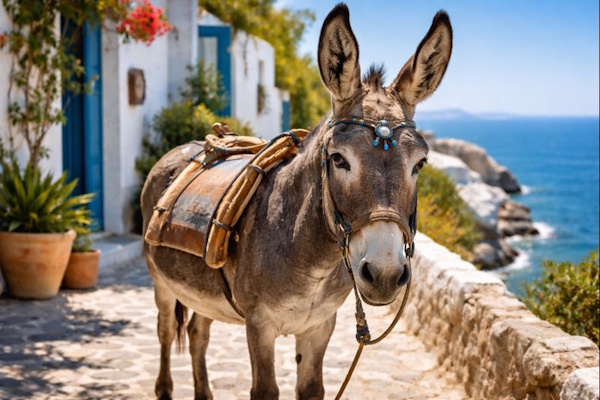
1. The Donkey – The Oldest Working Animal of the Mediterranean
The donkey (Greek: gáidaros – γάιδαρος) was already used as a pack animal in antiquity.
Its ancestors came from North Africa; They arrived in Europe early on via Crete and Cyprus.
They are robust, undemanding, and perfectly suited to Greece’s climate:
they tolerate heat better than horses,
need little water,
move safely on steep, rocky paths.
💡 Homer already mentioned donkeys in the “Iliad” – as a symbol of endurance and strength.
2. Donkeys in the Past – Indispensable Helpers
Until the 1960s, the donkey was the most important means of transport in Greece:
It carried water, olives, wood, and grapes,
took children to school,
and served farmers as riding and working animals.
Cars couldn’t drive in the narrow streets of many villages – so the donkey helped.
The Greek postal service was also delivered by donkey in remote regions.
3. The Donkey on the Islands
Donkeys are a common sight, especially on the islands:
| Island | Special feature |
|---|---|
| Santorini | Donkeys as a means of transport on the steps of Fira – but animal welfare is an issue |
| Hydra | No cars allowed, donkeys transport everything |
| Nisyros & Symi | Donkeys for hiking & freight |
| Crete | Farmers still use donkeys in mountain villages |
| Rhodes and Karpathos | occasionally used as working animals |
| Cyprus (not Greece, but similar) | Wild donkeys in the Akamas region |
💡 On Hydra, donkeys are still officially registered as “means of transport”—they carry food, building materials, and luggage through the narrow alleyways.
4. Donkeys on Santorini – Tradition & Controversy
Santorini is the most famous “donkey island” in Greece – primarily because of the steep steps between the port and the town of Fira.
In the past, donkeys were the only way to transport people and goods up the stairs.
Today, the donkeys are a tourist attraction, but also a matter of animal welfare.
🐾 Facts:
Around 200 donkeys and mules work in Fira and Oia.
The path to the old port has over 500 steps.
Summer temperatures often exceed 35°C (95°F).
Animal welfare organizations regularly call for tourists to refrain from riding donkeys in extreme heat.
Many owners have now installed sunshades, shady spots, and watering stations.
💡 Those who don’t want to burden the animals can comfortably take the cable car.
5. Donkeys on Hydra – the car-free paradise
Hydra is one of the few islands in the world where cars are prohibited.
Everything is transported by donkeys:
Tourists’ suitcases,
Building materials,
Garbage, food, furniture.
Around 200 animals live there, cared for by experienced keepers.
The animals are part of everyday life – you’ll see them at the harbor, during shop construction, or on their way to the market in the morning.
💡 The donkeys of Hydra are considered the best cared for in Greece – veterinarians and associations pay close attention to their well-being.
6. Donkey Keeping Today
In the mountains of the mainland and on some islands, donkeys are still used for light work –
e.g., transporting sacks of olives, firewood, or water canisters.
Otherwise, donkeys today are primarily:
Pet or mascot on farms,
Part of rural tourism,
or rescue animals in shelters.
Today, there are approximately 25,000–30,000 donkeys left in Greece – there used to be over a million.
7. Animal Welfare and Donkey Organizations
Several organizations care for the well-being of donkeys:
Greek Animal Welfare Fund (GAWF)
Donkey Sanctuary Greece
Animal Action Hellas
They inspect stables, provide veterinary care, and train owners.
Regular health checks are conducted, especially on Santorini and in Thessaly.
💡 In Greece, there are even donkey farms for visitors, for example, on Crete (e.g., Agia Marina Donkey Rescue near Chania).
8. The Donkey in Greek Culture
Donkeys are considered patient, loyal, and undemanding in Greece.
In popular parlance, the gáidaros often represents “the quiet worker.”
It appears in many proverbs:
“Ton gáidaro ton déneis ekei pou theleis” – “You can tie the donkey wherever you want” (about people who have little say in things).
“San ton gáidaro tou Chatzipanagi” – “Like Chatzipanagi’s donkey” (someone who is difficult to lead).
💡 The donkey is also a lovable, somewhat stubborn character in songs and children’s books.
9. Donkeys and Children – Popular Encounters
Many farms and agritourism establishments in Greece offer donkey interactions for children:
Petting and brushing,
short walks,
Feeding them carrots or bread.
The animals are calm, friendly, and ideal for teaching children respect for animals.
10. Donkey Treks and Tourism
Some regions offer guided donkey treks – especially in Crete, Epirus, and Rhodes.
On these treks, the donkey carries luggage or children while the adults walk.
💡 Particularly well-known:
Donkey Trekking Crete (Lasithi Plain)
Donkey Walk Naxos
Rhodes Donkey Trails
These tours are popular with families – however, it’s important to choose providers who offer animal-friendly conditions (short distances, shade, water).
11. The Donkey in Religion and History
In Orthodox tradition, the donkey is considered humble and peaceful.
It symbolizes patience – even in Christian depictions (e.g., Jesus’ entry into Jerusalem).
Even in antiquity, donkeys were companions of gods like Dionysus, the god of wine, who is often depicted riding a donkey.
12. Donkeys and Agriculture
Even today, donkeys help in some villages with:
pulling small carts,
transporting olives and fodder,
accessing terraced fields inaccessible to machinery.
💡 On remote islands like Nisyros, Amorgos, or Anafi, donkeys can still be seen with saddlebags full of vegetables or water canisters.
13. Donkeys in Modern Society
Many Greeks now view the donkey with pride and nostalgia.
It represents a simple, honest life, patience, and serenity – values often lost in modern life.
The donkey also appears in advertising and tourism as a friendly symbol of rural life and tradition.
14. Donkeys and Art
Many Greek artists, photographers, and writers use the donkey as a motif:
A symbol of humility and perseverance,
A contrast between tradition and modernity,
A peaceful animal in the noisy summer.
In tavernas, you often see old photos of farmers posing with their donkeys – a reminder of the “quiet time” before the tourism boom.
15. Differences Between Donkeys and Mules
Many tourists confuse donkeys with mules.
A mule is a crossbreed of a male donkey and a female horse – stronger, larger, and more enduring. On Santorini and Hydra, mules, not pure donkeys, are the primary animals used.
| Characteristic | Donkey | mule |
|---|---|---|
| Size | smaller (1.2 m) | larger (1.4–1.6 m) |
| character | calm, stubborn, friendly | stronger, more eager to work |
| Loud | Eeyore | almost silent |
| use | light transport | heavy loads |
16. The donkey as a symbolic animal of Greece
Like the goat, the donkey symbolizes freedom, and the donkey represents perseverance and patience.
In mountainous regions, the saying goes:
“No donkey, no village.”
It’s not just a working animal, but part of the local identity – just like the olive tree or the white chapel on the hill.
17. Problems & Future
declining donkey population,
few new owners,
poor living conditions on tourist islands,
sporadic animal welfare checks.
At the same time, there is hope:
greater awareness among travelers,
better care by associations,
tourism projects with species-appropriate husbandry.
💡 The donkey will not disappear – it will evolve from a working animal to a cultural asset.
18. Encounters on Vacation – Tips
If you see donkeys:
always keep your distance,
don’t startle or touch them,
don’t give them snacks,
don’t ride them in extreme heat,
greet them politely – many owners appreciate interest.
💡 You’re welcome to photograph donkeys in villages – but please do so respectfully, without flash or noise.
19. Donkey Farms & Sanctuaries (Visit Tip)
| Place | Name | Description |
|---|---|---|
| Crete (near Chania) | Agia Marina Donkey Rescue | Nursing home for old donkeys, open to visitors |
| Corinth | The Donkeyland Sanctuary | Information center, volunteer work possible |
| Athens area | GAWF Donkey Program | mobile veterinary teams for donkeys |
| Lesbos | Donkey Rescue Lesvos | small farm with guided tours |
💡 These places are ideal destinations for families, animal lovers, or photography enthusiasts.
20. Conclusion – The Donkey: Greece’s Silent Companion
The donkey is much more than a photo opportunity.
It represents tradition, patience, and rural life.
Even though tractors and cars have replaced it, it remains part of the Greek soul.
👉 In short:
a loyal companion of the Greeks for millennia,
important for culture, agriculture, and tourism,
a symbol of patience and down-to-earthness,
animal welfare is increasingly taken seriously.
Anyone who sees a donkey in Greece encounters a piece of history – quiet, friendly, and unforgettable. 🇬🇷🫏
Animals in Greece – all our pages