🐐 Free, cheeky, and typically Greek
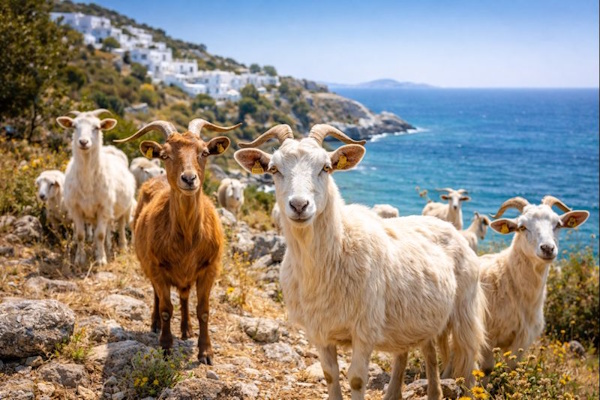
Anyone traveling through Greece—whether on Crete, Rhodes, Naxos, or the mainland—sees them almost everywhere: goats on rocks, roads, or rooftops.
They are as much a part of the country as olive trees, tavernas, and sunshine.
Greece has around 3.5 million goats—more than almost any other EU country.
They provide milk, cheese, and meat, help with landscape management, and are an integral part of Greek culture.
In this article, you will learn:
why there are so many goats in Greece,
where you can see them,
what role they play in cheese production and the economy,
and how to behave if you encounter a herd.
See also: Donkeys in Greece
See also: Sheep in Greece
1. Goats—Survival Artists of the South
Goats thrive in dry, hot, and poor soils.
They find food where hardly anything grows – thorns, herbs, thyme, even olive branches.
That’s why they are particularly widespread in mountainous regions and islands where farming is difficult.
In many areas, they are even more important than sheep, for example on Crete, Karpathos, Samos, Naxos, and in the Mani region.
💡 Fun Fact:
Some Cretan goats climb trees up to ten meters high to eat leaves!
2. History of goat farming
Goats played a significant role even in ancient times:
They were considered a symbol of strength, fertility, and freedom.
The god Pan – half man, half goat – still represents nature and the joy of life.
For millennia, goats have provided:
Milk for cheese and yogurt,
Meat for feasts,
Skins and leather,
Manure as natural fertilizer.
3. Typical Goat Breeds of Greece
| race | Origin | Special feature |
|---|---|---|
| Kri-Kri goat | Crete & the Small Aegean Islands | wild, threatened with extinction |
| Skopelos goat | Northern Greece | high milk yield |
| Epirus goat | Mountain region | robust, undemanding |
| Carystos goat | Euboea | very adaptable |
| Cretan goat (domesticated) | Crete | intense milk, aromatic |
💡 Greece is one of the few countries in Europe with wild goat populations – the famous Kri-Kri.
4. The Wild Kri-Kri Goat
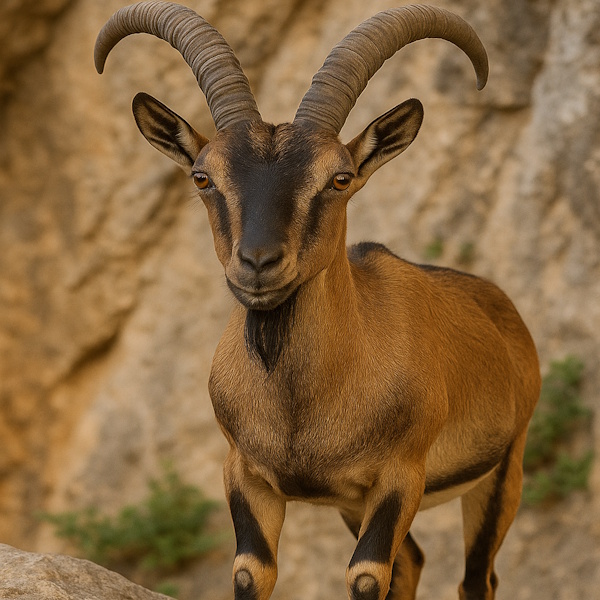
The Kri-Kri goat (Cretan wild goat) lives on Crete and small surrounding islands such as Thodorou, Agii Pantes, and Sapientza.
It is shy, strong, and climbs rocks with ease.
Weight: up to 80 kg
Horns: long, curved backward
Coat: brown with a black stripe down its back
It is considered the symbolic animal of Crete and is strictly protected.
The best places to observe it are in Samaria National Park or the Thodorou Nature Reserve near Chania.
5. Goats and Cheese – The Basis of Greek Cuisine
Around 30% of Greek milk comes from goats.
Goat’s milk is aromatic, easily digestible, and the basis of many specialties:
| Cheese | Milk | Origin | The taste |
|---|---|---|---|
| Feta | 30% goat + 70% sheep | all of Greece | creamy, salty |
| Graviera Naxou | Goat/Sheep | Naxos | nutty, firm |
| Mizithra | Goat + Sheep | Crete | mild, fresh |
| Anthotyro | Goat | Northern Greece | soft, slightly sweet |
| Kefalotyri | Goat + Sheep | Peloponnes | strong, spicy |
💡 Many small cheese dairies sell directly from the farm – often without a label, but with an unforgettable taste.
6. The Annual Cycle of Goat Farming
Winter: Time in the barn, kids are born.
Spring: Milking season; cheese production begins.
Summer: The animals move to the mountains.
Autumn: Return to lower elevations, cheese sales.
Traditionally, a shepherd accompanies the herd, often with 2-3 dogs.
In Crete, many shepherds live for months at a time in small stone huts (“mitáta”) in the mountains.
7. Goats in Crete – Ubiquitous
Crete is the land of goats par excellence.
Over 1 million goats live here.
You see them on rocks, at roadsides, even on walls – true climbing experts.
Well-known regions:
Anogia and Psiloritis Mountains,
Sfakia and Lefka Ori,
Kriti South Coast (Agia Galini, Plakias).
💡 Especially delicious: Cretan goat cheese and goat meat with honey (“katsikaki me meli”).
8. How to behave when encountering goats
If you encounter goats on roads or hiking trails:
Drive slowly, they won’t run away,
Don’t honk your horn,
Keep your distance (especially from young goats),
Don’t feed them,
Beware of sheepdogs – they protect the herd.
💡 Tip:
Goats are curious – sometimes they nibble on bags when you stop.
9. Goats and the environment
Goats help keep barren landscapes open,
but too many animals lead to overgrazing.
Therefore, herd sizes are controlled on Crete and Lesbos.
EU programs promote sustainable grazing and protect sensitive areas such as gorges and national parks.
10. Goats and Festivals
Goat meat is often served at Easter or village festivals – grilled or braised.
Popular dishes:
“Katsikaki sto fourno” (goat roasted in the oven)
“Zygouri” (older animal, slow-cooked)
“Antikristo” (roasted on a spit over an open fire)
Goat meat is considered particularly flavorful because the animals eat wild herbs.
11. Goats in Greek Mythology
The god Pan has goat horns and legs.
According to legend, the goat Amalthea nursed the infant Zeus with milk.
The star Capella (“little goat”) commemorates this story.
Goats thus symbolized vitality, fertility, and a connection to nature even in ancient times.
12. Important Regions with Goat Farming
13. Economic importance
Greece produces over 400 million liters of goat’s milk annually.
Approximately 60% of this is processed into cheese.
Greece is the largest goat’s milk producer in the EU.
Many farmers make their living solely from milk and cheese sales – often combined with tourism or direct sales.
14. Tourist Experiences with Goats
More and more agritourism businesses offer:
Cheese tastings,
Milking workshops,
Farm tours.
On Crete or Naxos, you can sample fresh goat’s milk, cheese, and yogurt at weekly markets.
💡 Especially beautiful: Shepherd’s trails around Anogia, the Aradena Gorge, and the mountains of Naxos.
15. Goat’s Milk Products
Cheese: Feta, Graviera, Mizithra, Anthotyro
Yogurt: creamy, tangy flavor
Cosmetics: soaps, creams with goat’s milk
Meat: grilled, braised, with herbs
Souvenirs: small cheese molds, goat leather products
16. Problems & Challenges
Decline in the number of young herders,
falling milk prices,
competition from cheap imports,
overgrazing in sensitive areas,
attacks by stray dogs or wolves.
Nevertheless, goat farming remains important – also for sustainable tourism and regional products.
17. Curiosities
Some islands have more goats than inhabitants.
In the mountains, they wear bells with different tones – each herder recognizes his animals by their sound.
On Karpathos, goats sometimes live on rooftops because they find shade there.
18. Goats and Tourism
Tourists love them – but many don’t realize how important they are to the ecosystem.
Goats eat weeds, prevent erosion, and keep the land open.
They are a symbol of rural Greece – peaceful, free, and always on the move.
19. Encountering the Kri-Kri on Vacation
If you’re lucky, you might see them on Crete or the island of Thodorou (accessible by boat from Chania).
There, they live freely but are protected.
A rare moment – and one of the most beautiful nature experiences in Greece.
20. Conclusion – Goats are as much a part of Greece as sun and sea
Goats are a piece of Greek identity – robust, independent, and vibrant.
They provide cheese, maintain the landscape, and accompany travelers on almost every island.
👉 In short:
Greece = Land of Goats
Economically and ecologically important
Kri-Kri = Symbolic animal of Crete
Peaceful encounters, please be respectful
Observing the goats in Greece allows you to experience the true life of the country – connected to nature, simple, authentic. 🇬🇷🐐