🦎 Species, Habitats & Observation Tips
Lizards are a common sight in Greece. Whether in the mountains, on the islands, or on old stone houses – these small, fast reptiles scamper through the sun everywhere.
For many tourists, they are a familiar sight, and for children, often a small attraction.
With its warm climate and diverse landscape, Greece is a true paradise for lizards.
In this article, you’ll learn which species live here, where you can best observe them, and what you should know about their behavior.
🌞 Why there are so many lizards in Greece
Greece has over 300 days of sunshine a year – ideal conditions for reptiles.
Lizards are cold-blooded animals; they need warmth to become active.
On rocky slopes, walls, or among olive trees, they find exactly what they need: sun, shelter, and plenty of insects to eat.
They are most commonly seen:
on old ruins and walls
on rocks and stone paths
in the mountains on dry stone walls
in gardens, especially on islands like Crete, Naxos, or Rhodes
🐍 The Difference Between Lizards and Snakes
Many tourists are startled when something scurries quickly through the grass – but it’s usually a harmless lizard.
Typical characteristics:
short body,
four legs,
tail often twice as long as the body,
quick movements in short bursts.
Unlike snakes in Greece, lizards flee immediately when threatened and are completely harmless.
🦎 Common Lizard Species in Greece
Greece has over 20 native species – some of which are found only here.
Here are the most common species you’re likely to see as a tourist:
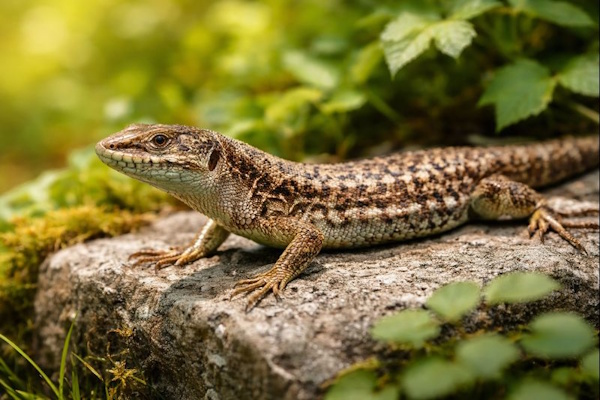
🟢 Wall Lizard or Ruin Lizard (Podarcis muralis)
Most common species in Greece
Lives on stone walls, ruins, and house facades
Length: 15–20 cm
Color: greenish to brown with dark spots
Very agile, often basks on top of walls
🟢 Balkan Lizard (Podarcis tauricus)
Lives in meadows and olive groves
Highly adaptable
Greenish with a light stripe down its back
Grows up to 25 cm long
Eats insects, spiders, and small beetles
This species is often seen in spring when the sun isn’t too hot.
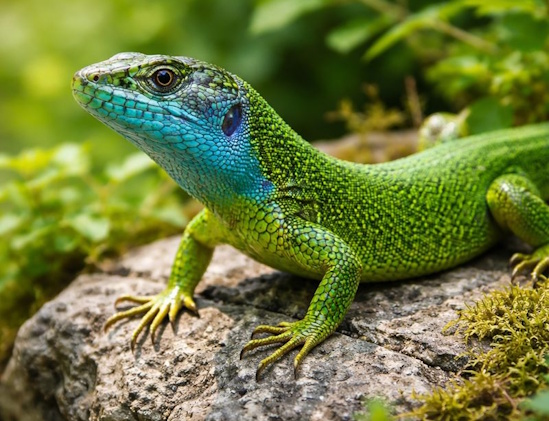
🟢 Green Lizard (Lacerta viridis)
One of the most beautiful species in Europe
Deep green with a blue throat (especially in males)
Length: up to 35 cm
Lives in bushes, on slopes, and at forest edges
Very shy, but strikingly colored
With a bit of luck, you can observe them in Crete, Euboea, and northeastern Greece.
🟢 Aegean Wall Lizard (Podarcis erhardii)
Endemic species of the Aegean Sea – lives only on the Greek islands
Small (up to 20 cm)
Highly variable in color – from grayish-brown to green
Particularly common on Naxos, Paros, Santorini, and Mykonos
It is the quintessential island lizard: lightning-fast, diurnal, and perfectly adapted to arid conditions.
🟢 Cretan Wall Lizard (Podarcis cretensis)
Native only to Crete
Olive-green with a lighter underside
Lives in stone walls and gardens
Very curious – sometimes allows itself to be photographed at close range
🌿 Habitats
Lizards love warmth, but they also need hiding places.
That’s why you’ll find them especially where sun and shade alternate:
Old stone walls and ruins
Dry fields and roadsides
Vineyards and olive groves
Walls in villages or hotel complexes
Even in tourist areas like Rhodes Town or Chania in Crete, you can observe them – often right on the walls of tavernas.
🕷️ Diet
Lizards are insectivores.
They catch:
Flies
Ants
Small beetles
Spiders
Mosquitoes
Sometimes they also hunt small butterflies or grasshoppers.
They are very active in the summer, while in winter they enter a kind of dormant phase and hide in cracks in walls or under stones.
🧬 Tail shedding – a survival trick
If a lizard is threatened by a cat or a bird, it can shed its tail.
It twitches for a few more seconds, distracting the attacker.
Later, the tail grows back—usually a bit shorter and lighter in color.
This is completely normal and doesn’t harm the animal.
🐣 Reproduction
In spring, usually in April or May, the males begin courting.
They become more colorful, bob their heads, and chase away rivals.
After mating, the females lay 2–8 eggs in loose soil or under stones.
After 6–8 weeks, tiny young hatchlings emerge and are immediately independent.
🏝️ Lizards on the Islands
Each Greek island has its own species of lizard.
Because many islands were isolated for millennia, unique subspecies have developed there.
| Island | Most common type | Special feature |
|---|---|---|
| Crete | Cretan wall lizard | endemic, curious |
| Rhodes | Aegean wall lizard | typical for villages & walls |
| Naxos | Aegean wall lizard | very common, light colored |
| Corfu | Emerald lizard | large specimens, deep green |
| Peloponnes | Balkan lizard | often in fields |
📸 Observation tips
Lizards are most active in the early morning – they bask in the sun after the night.
Move slowly and stand still – they often approach you on their own.
Many can be seen, especially in spring, and more often in the mornings and evenings during the height of summer.
Good places to spot them: walls of old houses, dry fields, monastery grounds, ruins.
💡 Tip:
Binoculars or a small camera with zoom are helpful without disturbing the animals.
⚠️ Protection and Threats
Lizards are protected animals in Greece.
Catching or killing them is prohibited.
The main threats are:
Cats and crows
Road traffic
Habitat loss (development, fire)
In recent years, conservation projects in Crete and the Cyclades have been promoting the preservation of these animals – especially endemic species.
🧭 Conclusion: Tiny sun-lovers with big charm
Lizards are as much a part of Greece as olive trees and the chirping of cicadas.
They are harmless, curious, and fascinating to watch.
If you look closely, you’ll spot them everywhere – on stone walls, at tavernas, or along the paths to beaches and villages.
A little piece of Greek nature that you can experience up close with a bit of patience.
Animals in Greece – all our pages