🐑 Landscape, Tradition, and Cheese
Anyone driving through Greece will hear them everywhere: the bells of sheep.
Whether on Crete, Naxos, the Peloponnese, or in the mountains of Epirus – sheep are as much a part of the country’s landscape as olive trees and white houses.
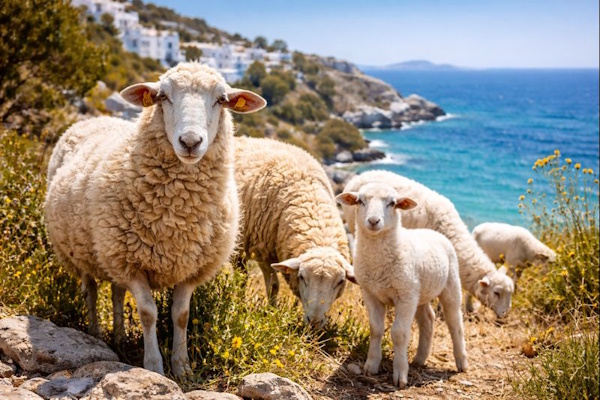
More than 8 million sheep live in Greece, almost as many as people.
They provide milk, cheese, and meat – and have shaped the landscape for millennia.
This article will show you:
why there are so many sheep in Greece,
where you can see them,
what role they play in culture and cuisine,
and how to treat them respectfully if you encounter them while hiking or driving.
1. Sheep – Part of the Greek Landscape
Sheep can be seen everywhere:
on mountain slopes covered in thyme,
in olive groves,
or along the roadside of small mountain roads.
They help keep vegetation short and prevent fires by grazing on dry grasses.
They are a defining feature of the landscape, especially on Crete, Lesbos, Naxos, Karpathos, and in Epirus.
💡 Fun Fact:
There are more sheep than people on Crete – about 1.2 million animals.
See also: Goats in Greece
See also: Donkeys in Greece
2. History of Sheep Farming in Greece
Sheep farming is ancient. As early as the Minoan period (2000 BC), wool was processed and sheep’s milk was made into cheese.
In antiquity, sheep were considered a symbol of wealth and offerings to the gods.
To this day, sheep farming is mostly traditional and family-run:
Small flocks of 50–200 animals,
Daily milking by hand or with mobile milking systems,
Grazing almost year-round.
3. Important sheep breeds in Greece
There are many local breeds, adapted to climate and terrain.
| race | Origin | Special feature |
|---|---|---|
| Chios sheep | Chios Island | very high in milk, feta base |
| Kefalonia sheep | Ionian Islands | robust, resistant |
| Lesbos sheep | Lesbos Island | aromatic milk, for graviera |
| Serres sheep | Northern Greece | good meat quality |
| Sfakia sheep | Crete (Sfakia region) | Mountain pastures, intense flavor |
💡 This diversity means that Greek cheese tastes different from region to region.
4. Sheep and Cheese – Greece’s Culinary Heritage
The most well-known sheep products are Feta, Graviera, Kefalotyri, and Mizithra.
Almost all Greek cheeses are made from sheep’s or goat’s milk – cow’s milk is rare.
| Cheese | Milk | Origin | The taste |
|---|---|---|---|
| Feta | 70% sheep + 30% goat | all of Greece | salty, creamy |
| Graviera | sheep | Crete, Naxos | nutty, firm |
| Kefalotyri | sheep | Peloponnes | spicy, tough |
| Mizithra | Sheep/Goat | Crete | mild, fresh |
💡 Feta is legally protected:
Only cheese made from sheep’s and goat’s milk from Greece may be called “Feta” (EU Protected Geographical Indication seal).
5. Sheep Farming Throughout the Year
Winter: Animals remain in barns in the valley, and ewes give birth to lambs.
Spring: Flocks move to pastures, and milk production begins.
Summer: Sheep graze on barren mountaintops, and shepherds live in simple shelters.
Autumn: Return to the valley; cheese is stored and sold.
This transhumance (migratory sheep farming) still shapes many regions today, such as Crete and the Pindus Mountains.
6. Where to See Sheep in Greece
| region | Description |
|---|---|
| Crete | everywhere in the mountains, especially around Anogia and Psiloritis |
| Peloponnese (Taygetos, Mani) | often along small mountain roads |
| Epirus (Zagoria, Ioannina) | traditional shepherd region |
| Naxos & Paros | many sheep pastures in the island’s interior |
| Lesbos | known for cheese and yogurt production |
| Macedonia / Thrace | large pastures, often mixed with goats |
💡 On hikes, you can often hear the bells long before you see the animals.
7. How to behave when encountering sheep
If you encounter sheep by car or on foot:
Drive slowly; the animals move at a leisurely pace.
Don’t honk your horn—they are easily startled.
Keep your dog on a leash, especially around lambs.
Do not feed or pet the sheep, even if they seem friendly.
There is usually a shepherd or sheepdog behind the flock—show respect and greet them politely (“Kaliméra!”).
8. Shepherds and the Shepherd’s Life
Life as a shepherd in Greece is hard, but respected.
Many families have practiced it for generations.
Typical practices:
Getting up before sunrise,
Herding with 2–3 dogs,
Making cheese directly in small mountain huts (“mitato”).
In Crete, sheepdogs (Kritikos Poimenikos) are legendary—strong, intelligent, and loyal.
9. Importance for the Environment & Landscape Management
Sheep keep the grass short, promote flowering plants, and help prevent forest fires.
Without grazing, many regions would quickly become overgrown with shrubs.
The EU therefore promotes traditional sheep farming within the framework of agri-environmental programs.
10. Sheep & Religion/Culture
In the Orthodox faith, the sheep symbolizes purity and sacrifice – many festivals include lamb dishes, for example:
Easter: traditionally, a whole lamb is roasted,
St. Nicholas Day & village church festivals: communal meals with meat and wine.
💡 Lamb on a spit (“arni sta karvouna”) is one of the most popular festive dishes in Greece.
11. Sheep in the Greek Language & Idioms
Greek has many proverbs featuring sheep:
“San to prováto sto sfageío” – “Like a sheep to the slaughter” (unwittingly).
“Metráei ta prováta” – “He counts the sheep” (falls asleep).
“To mavro prováto” – “The black sheep” (outsider).
💡 “Prováto” (πρόβατο) = sheep, “arni” (αρνί) = lamb.
12. Sheep Products for Tourists
Typical souvenirs or specialties:
Cheese (Feta, Graviera, Mizithra)
Lamb sausage (“loukaniko arnisio”)
Wool, hides, handmade blankets
Cosmetics with sheep’s milk (soap, cream)
Many farmers’ markets offer local products directly from the producers.
13. Sheep Farming Today – Between Tradition and Tourism
Many young Greeks are returning to rural areas and modernizing sheep farming:
better barns,
mobile milking systems,
online sales of cheese and meat.
On Crete and Naxos, there are even agritourism farms where tourists can watch cheese being made.
14. Economic Importance
Sheep farming is an important part of agriculture:
Around 25% of Greek agricultural production comes from milk and cheese.
Greece is the largest feta producer in Europe.
Exporting countries: Germany, Italy, France.
15. Problems and Challenges
falling milk prices,
emigration of young people,
competition from cheap imported cheese,
wolves in northern Greece (shepherds protect their flocks with dogs).
The government provides support for pasture farming and cheese production with EU subsidies.
16. Sheep & Tourism
Sheep are part of the Greek experience:
Hikers on Crete or in the Pindus Mountains constantly hear them, and drivers often have to stop briefly.
💡 Photo tip:
Sheep flocks look particularly photogenic in the morning or evening when the light is soft – with the sound of bells in the background.
17. Sustainability & Future
Traditional sheep farming is environmentally friendly:
no overgrazing,
regional cycles,
use of local resources.
More and more products carry labels such as “PDO” (Protected Designation of Origin) or “organic,” e.g., “Organic Feta from Epirus.”
18. Encounters in Everyday Life
You sometimes see vans with sheep on ferries – common in island regions.
They occasionally block the road on country roads.
On hiking trails, you’ll encounter peaceful flocks – stay calm and keep your distance.
19. Curiosities
According to statistics, there are 1.2 million sheep for Crete’s 600,000 inhabitants.
Some shepherds can identify each animal by the sound of its bell.
In mountain villages, lambs are often given as gifts for name days.
20. Conclusion – Sheep are Greece’s quiet companions
Sheep are an integral part of Greece:
They shape the landscape, influence the taste of the cheese, and symbolize the tranquility of rural life.
Whether on Crete, Naxos, or in the Pindus Mountains – their sound is the natural background noise of the Greek summer.
👉 In short:
Sheep = everyday life + culture
important economic sector
environmentally friendly grazing
Encounters are perfectly normal for tourists
Those who treat them with respect experience a piece of authentic Greece – far from the beach and hotel bar. 🇬🇷🐑