🦑 Fascinating Hunters of the Sea and a Popular Delicacy
Few animals embody the Greek sea as much as the octopus.
Whether snorkeling among rocks, fishing in the evening, or enjoying a meal at a taverna – octopuses are as much a part of Greece as sunshine and olive oil.
The Greeks call them “χταπόδι” (chtapódi), “καλαμάρι” (kalamári), or “σουπιά” (supiá), depending on the species.
These terms refer to three different species, all belonging to the same zodiac, but differing in lifestyle, appearance, and taste:
🐙 Octopus (Octopus vulgaris) – eight arms, lives on the seabed.
🦑 Squid (Loligo vulgaris) – ten arms, fast swimmer.
🐚 Cuttlefish, or squid in the strict sense (Sepia officinalis) – broad body with an ink sac.
Below you’ll learn where to observe, catch, and enjoy them in Greece – and why they are so important to the ecosystem.
See also: Food in Greece (our full article)
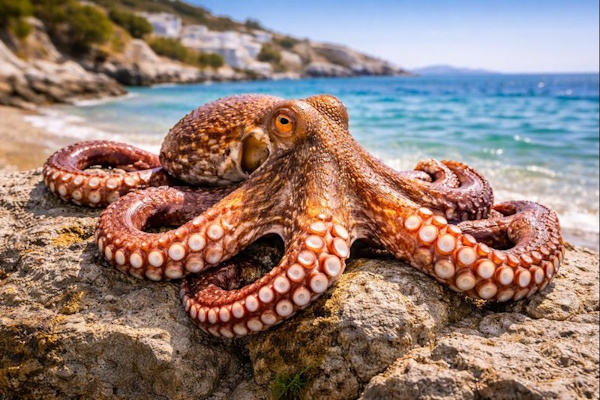
Habitat & Behavior
Squid live in all coastal waters of Greece – from shallow sandy beaches to depths of 200 meters.
They prefer rocks, seagrass meadows, and small caves, where they hide during the day.
Activity: mostly at night; they rest during the day.
Camouflage: They can change color in seconds to blend into their surroundings.
Diet: small fish, shrimp, and crabs.
Lifespan: usually only 1–2 years, but they grow quickly.
You can see particularly large numbers of squid in spring and autumn, when the sea is calmer and cooler.
Book accommodation in Greece now
Our tip
For hotels in Greece, the best option is Booking.com: a wide selection from guesthouses to resorts, genuine guest reviews, flexible (often free) cancellation, and fair prices.
Species of squid in Greece
🐙 Octopus (χταπόδι)
The most well-known representative – with eight arms and a large head.
Lifestyle: lives on the seabed, usually among rocks.
Identifying features: large eyes, flexible skin, powerful suckers.
Behavior: extremely intelligent, can open cans or make tools.
Camouflage: changes the color and texture of its skin in a flash – from gray to brown, red, or white.
While snorkeling, you often see it moving slowly over rocks or retreating into a hole with lightning speed.
Its presence is betrayed by small piles of empty shells in front of its cave.
🦑 Squid (καλαμάρι)
The “classic” squid from the kitchen.
Body: elongated, with fins at the end.
Arms: ten – eight short, two long tentacles.
Lifestyle: Lives free-swimming in open water.
Movement: Swims using jet propulsion – water is expelled through a funnel.
Observation: Often attracted to light at night, e.g., at harbors or boats.
The squid is a fast hunter that travels in groups – fascinating to watch while night diving.
🐚 Cuttlefish (Sepia)
Somewhat more compact and rarer, but also typical.
Characteristics: Oval body with a calcareous shell (cuttlefish shell), two tentacles.
Color: Marbled brown and white, can change color in a flash.
Lifestyle: Lives over sandy and muddy bottoms, often near the coast.
Ink: Particularly dark, expelled for defense.
The cuttlefish is a popular subject for underwater photographers – elegant, serene, and inquisitive.
Squid watching – where and when?
Squid can be found in all Greek waters, but they are best seen where rocks meet sand.
Here are a few top spots for observation:
| Island / Region | Observation sites | Special features |
|---|---|---|
| Crete | South coast (Plakias, Matala, Elounda) | many rocky coves, calm water |
| Rhodes | Anthony Quinn Bay, Ladiko | Octopuses easily visible on rocks |
| Naxos | Agia Anna, Alyko | clear water, shallow seagrass zones |
| Santorini | Vlychada, Ammoudi Bay | Lava rock, cuttlefish and small squid |
| Mykonos | Lia Beach, Agrari | Good visibility, octopuses among the rocks |
| Peloponnes | Kardamyli, Finikounda | best visibility in spring |
| Corfu | Paleokastritsa | Squid and small octopuses while snorkeling |
💡 Tip:
Octopuses are more active in the early morning or at dusk.
If you remain calm and avoid sudden movements, you can observe them up close.
Octopuses in Everyday Greek Life
In Fishing
For many fishermen, octopuses are an important source of income.
They are caught with special lures (called “calamari”), usually at night.
Fishing boats with lights attract the animals – they react with curiosity and approach.
In some regions (e.g., Crete or Lesbos), octopus fishing is a traditional winter activity.
In the Kitchen
Few Greek dishes are as typical as “χταπόδι στη σχάρα” – grilled octopus.
After being caught, the octopus is traditionally “tenderized” by pounding it on rocks to soften the meat. Afterward, it’s often hung in the sun to dry—a familiar sight in seaside tavernas.
Corfu Cuisine
Popular Preparations:
Grilled with olive oil and vinegar
In red wine sauce (χταπόδι κρασάτο)
With pasta (χταπόδι με μακαρόνια)
Fried calamari rings
Cuta with rice and herbs
Greeks eat almost all parts—including the tentacles and tentacles—and use the ink in sauces or pasta dishes.
Sustainability & Conservation
Cuta are not an endangered species, but overfishing can impact local stocks.
They grow quickly but have short life cycles—this helps keep stocks stable.
Intensive night fishing with light traps, which attracts young animals, is problematic.
Some regions (e.g., around Crete) have introduced voluntary closed seasons to protect the population.
For divers and snorkelers:
Do not touch or remove any animals from caves.
No flash photography – squid are sensitive to light.
Never swim on ink clouds – this is their escape mechanism.
Biological characteristics
Squid are highly intelligent – researchers consider them among the most intelligent invertebrates on Earth.
Their brainpower is roughly equivalent to that of a raven.
They learn through observation.
They can distinguish shapes and colors.
They remember places and people.
Their color changes are also spectacular:
Pigment cells (chromatophores) react lightning-fast to stimuli and change skin patterns.
This allows them to communicate, hunt, or camouflage themselves.
Octopuses and Mythology
Even in ancient times, these creatures fascinated the Greeks.
Octopuses and cuttlefish are frequently depicted in Minoan frescoes on Crete (e.g., at Knossos) – as symbols of the sea and its mysterious power.
In Greek mythology, the octopus was often associated with the god Poseidon.
Its eight arms were considered a symbol of agility, adaptability, and survival – qualities that were also important to the Greeks living by the sea.
Octopuses and Tourism
Many tourists experience their first octopus while eating it, but more and more are becoming interested in these animals in their natural habitat.
Diving schools on Crete, Rhodes, Santorini, and Naxos offer special “octopus dives.”
While snorkeling, they can often be seen at depths of just two to three meters.
Children are also delighted when they observe small octopuses in shallow water – they seem curious and almost friendly.
Health & Nutrition
Octopus meat is high in protein, low in fat, and rich in minerals.
100 grams contain approximately:
15–18 g protein
very little fat
high in iodine, zinc, and selenium
The only drawback: high cholesterol content.
For most vacationers, however, grilled octopus is a light, healthy meal.
Regional specialties with squid
| region | Court | Description |
|---|---|---|
| Crete | Χταπόδι κρασάτο (Octopus in wine sauce) | With onions, red wine, tomatoes |
| Santorini | Grilled octopus with fava beans | Served with yellow pea puree |
| Lesbos | Kalamarakia tiganita | Deep-fried calamari rings |
| Rhodes | Sepia with rice and dill | In a light olive sauce |
| Athens / Mainland | Octopus salad | With lemon and parsley |
| Naxos | Octopus with noodles | Rustic dish with tomato sauce |
Tips for Observing & Photographing
Swim slowly, no sudden movements.
Keep your distance – 2 meters is sufficient.
Do not follow or touch.
Use your camera without a flash.
The best viewing opportunities are in the early morning or when the sea is calm.
In short: Between myth, sea, and taverna
Octopuses are an integral part of Greece – as fascinating creatures underwater and as a staple of Greek cuisine.
They embody much of what defines Greece: intelligence, adaptability, simplicity, and a deep connection to nature.
Whether you discover an octopus while snorkeling or enjoy grilled calamari in a taverna, both are authentic pieces of Greek culture.
👉 In short:
To truly understand Greece, you should not only eat octopus but also experience it.